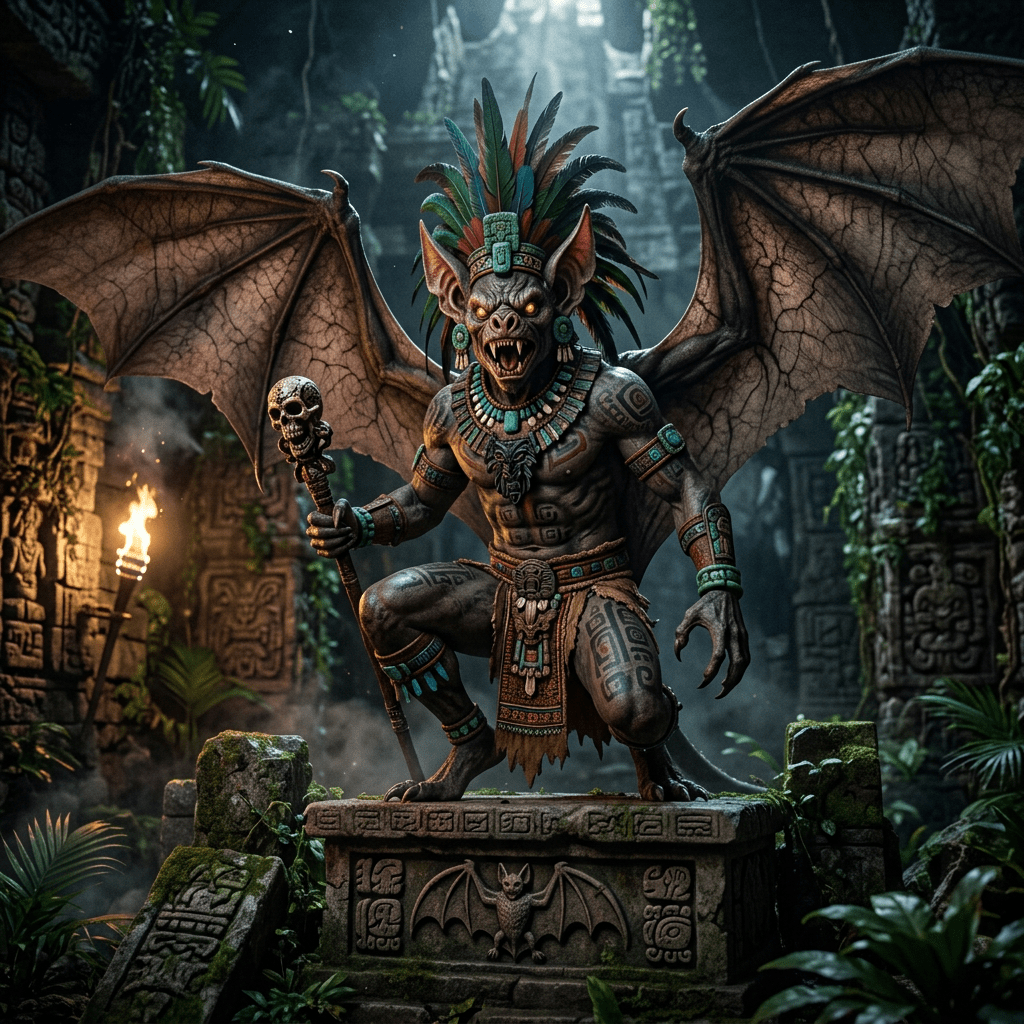
Among the many terrifying beings found in Mesoamerican mythology, few are as haunting as Camazotz, the monstrous death bat of Maya legend. Known throughout mythology as a creature of darkness and sacrifice, Camazotz appears in the sacred K’iche’ Maya text called the Popol Vuh, where he becomes one of the deadliest beings encountered in the underworld realm of Xibalba. His name comes from the K’iche’ Maya words kame, meaning “death,” and sotz’, meaning “bat,” creating the ominous title “Death Bat.” To the ancient Maya, bats were not simply nocturnal animals. They were mysterious creatures linked to caves, blood, the underworld, and supernatural transformation. Because bats emerged from caves at night and disappeared again before dawn, they were viewed as beings that moved between the worlds of the living and the dead.
Camazotz is most famous for his appearance in the Popol Vuh, the mythological narrative that tells the story of the Hero Twins, Hunahpu and Xbalanque. The twins descend into Xibalba, the Maya underworld, to challenge its cruel rulers through a series of deadly trials. Xibalba was not merely a place of punishment, but a dangerous spiritual realm filled with darkness, fear, disease, and supernatural traps. Among the terrifying chambers within the underworld was the House of Bats, known as Zotzilaha, where Camazotz and his monstrous bat servants lived. To survive the night, the Hero Twins hid inside their blowguns, using them as makeshift shelters against the deadly creatures flying through the darkness. However, before dawn arrived, Hunahpu became impatient and peeked outside to check whether the sun was rising. The moment he exposed himself, Camazotz struck with terrifying speed and decapitated him in a single blow, carrying away his severed head. This gruesome scene became one of the most famous moments in Maya mythology and established Camazotz as a symbol of sudden death lurking in darkness.
The symbolism of bats in Maya culture helps explain why Camazotz inspired such fear. In ancient Mesoamerica, caves were believed to be sacred entrances to the underworld and places where gods, spirits, and supernatural forces resided. Since bats lived within caves, they naturally became associated with hidden worlds and spiritual power. Some species of bats were also linked with blood due to their feeding habits, and blood itself held deep religious importance in Maya rituals. Ritual bloodletting and sacrifice were believed to nourish the gods and maintain balance in the universe. Camazotz therefore became a terrifying embodiment of sacrifice, mortality, darkness, and divine punishment. He represented the unpredictable dangers hidden beneath the earth and within the night itself.
Scholars continue to debate whether Camazotz should be viewed as a god, demon, spirit, or mythological monster. Some evidence suggests that the figure may have originated from older Zapotec bat deities before becoming integrated into Maya mythology. Ancient artwork across Mesoamerica depicts humanoid bat-like beings with claws, wings, and sacrificial imagery, suggesting that bat worship and bat symbolism existed long before the surviving written version of the Popol Vuh. Rather than fitting neatly into one category, Camazotz existed somewhere between deity and monster, serving as both a supernatural guardian of the underworld and a symbol of humanity’s fear of darkness and death.
Descriptions of Camazotz vary, but he is commonly portrayed as either a giant bat or a humanoid creature with bat-like features, including wings, claws, sharp teeth, and an intimidating presence. Some artistic depictions show him carrying sacrificial knives or severed heads, reinforcing his connection to ritual death. His terrifying appearance reflected the ancient belief that the darkness beyond human understanding contained forces both sacred and deadly. Unlike many modern monsters created purely for entertainment, Camazotz carried deep spiritual meaning within Maya cosmology.
Although the civilization that first told his stories declined centuries ago, Camazotz continues to survive in modern popular culture. He has appeared in fantasy novels, comics, games, films, and television series, often reimagined as a vampire-like demon or ancient bat god. Despite these modern adaptations, the original mythological figure remains far more complex and unsettling. Camazotz represents not only fear of death, but also the ancient Maya understanding that life, sacrifice, darkness, and rebirth were deeply connected. As one of the most memorable creatures in Maya mythology, the death bat continues to fascinate audiences with his blend of horror, mystery, and spiritual symbolism.
 The Hollow Files
Leave a comment