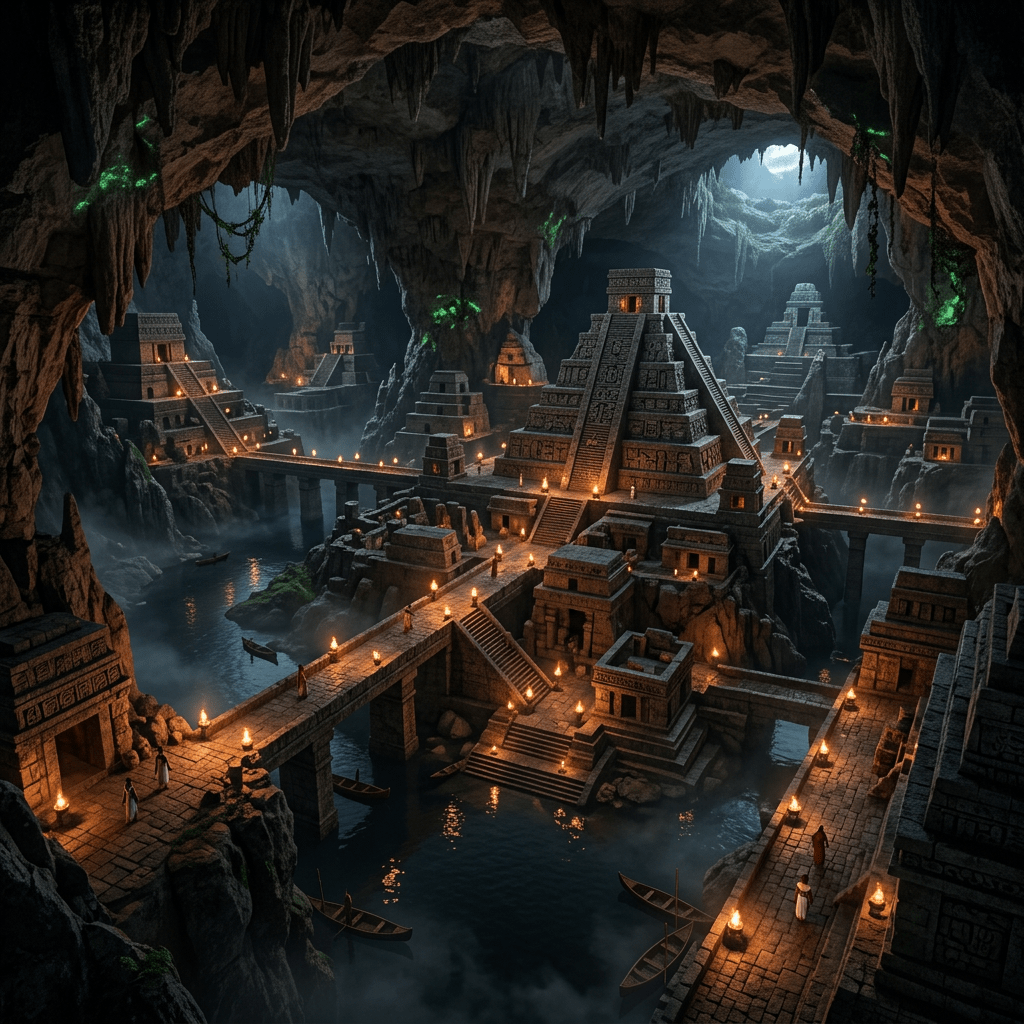
In the rich mythology of the ancient Maya, few places inspired more fear and mystery than Xibalba, the dark underworld ruled by death gods and filled with suffering, danger, and terrifying supernatural beings. Often translated as “Place of Fear” or “Place of Fright,” Xibalba played a central role in Maya cosmology and appeared most famously in the sacred K’iche’ Maya text known as the Popol Vuh. Unlike the simple idea of hell found in some later religions, Xibalba was a complex spiritual realm connected to death, disease, sacrifice, transformation, and the unseen forces beneath the world of the living.
The Maya believed the universe was divided into multiple layers of heaven, earth, and underworld realms. Beneath the human world lay Xibalba, a shadowy domain associated with decay, darkness, and supernatural power. It was ruled by powerful death deities who tested, punished, and deceived those who entered their realm. The most important rulers of Xibalba were Hun-Camé and Vucub-Camé, whose names are often translated as “One Death” and “Seven Death.” Alongside them were other terrifying lords associated with disease, starvation, pain, bloodshed, and human suffering. Together, these beings represented the dangers and hardships that ancient people feared most.
Xibalba is best known through the story of the Hero Twins, Hunahpu and Xbalanque, in the Popol Vuh. According to the myth, the twins descended into the underworld after the rulers of Xibalba challenged them. The death gods hoped to destroy the twins through a series of deadly trials and cruel tricks. Upon entering Xibalba, the twins encountered deception immediately, as the rulers attempted to humiliate them with fake thrones and confusing tests. Deeper within the underworld were terrifying chambers designed to kill or torture intruders. These included the House of Darkness, the House of Cold, the House of Jaguars, the House of Knives, and the infamous House of Bats, where the monstrous death bat Camazotz attacked the twins.
The trials within Xibalba were not only physical dangers but also spiritual tests of intelligence, courage, and survival. The rulers of the underworld relied heavily on trickery and psychological fear. However, the Hero Twins repeatedly outsmarted the lords of death through cleverness and supernatural abilities. Even after Hunahpu was decapitated by Camazotz, the twins eventually overcame the powers of Xibalba through deception of their own. In the end, they defeated the death gods and escaped the underworld, symbolizing triumph over death and chaos.
To the ancient Maya, Xibalba was not merely a mythological location but part of a broader understanding of the cosmos. Caves, deep forests, and underground rivers were often viewed as entrances to the underworld. Many Maya rituals took place inside caves because they were believed to connect the human world to supernatural realms below the earth. Archaeologists have discovered ceremonial sites and cave offerings throughout former Maya territories, suggesting that the underworld held deep religious importance in everyday life.
Some scholars believe that the Maya concept of Xibalba may have been inspired in part by real natural environments. Dense cave systems in Central America, particularly those filled with underground rivers, darkness, and dangerous terrain, could easily have inspired stories about a terrifying world beneath the earth. The Maya civilization also witnessed disease, warfare, sacrifice, and natural disasters, all of which became symbolically connected to the underworld and its rulers.
The imagery associated with Xibalba is often disturbing and symbolic. Death gods were commonly portrayed as skeletal or decaying figures adorned with bones, owls, jaguars, and symbols of blood and sacrifice. The underworld itself was imagined as a place where ordinary rules no longer applied, filled with fear, unpredictability, and supernatural terror. Yet Xibalba was not purely evil. In Maya belief, death and destruction were natural parts of existence and necessary for renewal and rebirth. The underworld therefore represented both an ending and a transformation.
Today, Xibalba remains one of the most fascinating elements of Maya mythology. It has appeared in novels, films, video games, comics, and fantasy stories inspired by ancient Mesoamerican culture. Modern portrayals often emphasize its horror and mystery, but the original myths reveal a far more complex spiritual realm tied to the Maya understanding of life, death, sacrifice, and cosmic balance. Through the stories preserved in the Popol Vuh, Xibalba continues to stand as one of the most haunting and unforgettable underworlds in world mythology.
 The Hollow Files
Leave a comment