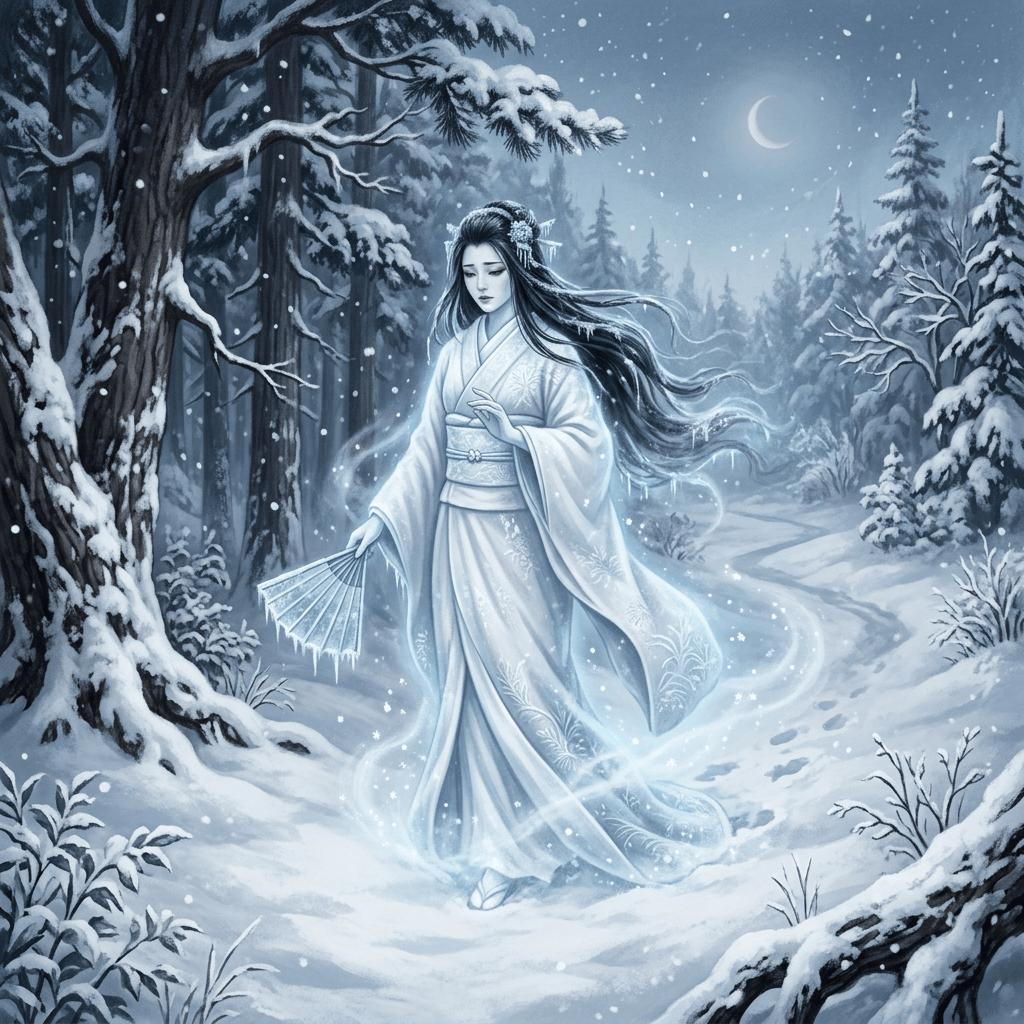
The legendary Yuki-onna, or “Snow Woman,” is one of the most haunting figures in Japanese folklore. Appearing during blizzards and freezing winter nights, she is described as an ethereal woman with pale skin, long dark hair, and a flowing white kimono that blends into the snow itself. Travelers lost in snowstorms are said to encounter her wandering silently through the mountains, where she can either guide them to safety or lead them to a frozen death.
The origins of Yuki-onna legends stretch back centuries across rural regions of Japan, especially in northern prefectures known for brutal winters. Different villages tell different versions of her story. In some tales, she is a cruel spirit who freezes travelers with her icy breath and drains their life force. In others, she is portrayed as tragic and lonely, a supernatural being bound to snow and winter.
One of the most famous retellings comes from writer Lafcadio Hearn in his 1904 collection Kwaidan. In the story, two woodcutters become trapped in a snowstorm and shelter inside a hut. During the night, a mysterious woman made of snow appears and kills the older man with her freezing breath. She spares the younger woodcutter, Minokichi, warning him never to tell anyone what he saw. Years later, Minokichi marries a beautiful woman named O-Yuki, only to discover she is the very same snow spirit.
Many interpretations view Yuki-onna as a personification of winter itself: beautiful, deadly, and impossible to hold onto. Some legends claim she is the spirit of women who died in snowstorms, while others describe her as a yokai born directly from snow and ice. Her stories often serve as cautionary tales about respecting nature and the dangers of wandering into storms alone.
In modern pop culture, Yuki-onna continues to appear in anime, manga, horror films, and video games. Despite her terrifying reputation, she is often portrayed with sadness and melancholy, making her one of the most emotionally complex creatures in Japanese mythology.
 The Hollow Files
Leave a comment